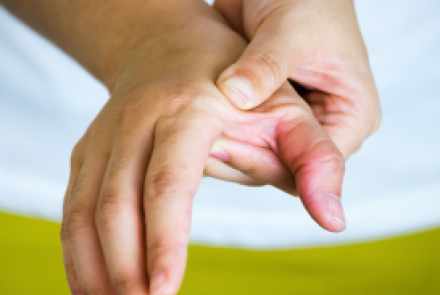
Feeling pain, swelling, or stiffness at the base of your thumb? You may be experiencing thumb arthritis, the second most common joint in the hand to develop this condition.
Arthritis at the base of the thumb usually starts early, around age 40, and becomes more prevalent in older people. It also tends to affect women 3-6 times more frequently than men and increases even more after menopause.
Neal Shuren, MD, orthopedic surgeon and specialist in disorders of the hand and upper extremity at Montefiore Einstein Orthopedic Surgery-Airmont, and explains how this type of arthritis develops and the treatment options that can help you feel better.
Pain in a pinch
From pain to crepitus, which is a catching or grinding sensation, arthritis at the base of the thumb can develop due to a variety of causes. Dr. Shuren shares that while there is a genetic component, the most common causes are activities that involve repetitive pinching. Professions or activities that can predispose someone to thumb arthritis include playing a stringed instrument, frequent needlework, hairstyling (from using scissors), and rock climbing.
Other causes include previous thumb injuries and a diagnosis of certain inflammatory conditions such as rheumatoid arthritis, lupus, or psoriatic arthritis, which are related to immune system problems.
Interestingly, with the rise of technology there is an increased risk of thumb arthritis, especially in people who constantly text with their thumbs or in people who partake in intense gaming,
Dr. Shuren says.
Treatment options
Luckily, most people with arthritis at the base of the thumb can be treated with conservative measures. Some of the treatment options include:
- Treat with heat. Dr. Shuren recommends paraffin wax baths as a good way to apply heat.
- Supplements. Use of over-the-counter supplements such as glucosamine and chondroitin sulfate.
- Splints to immobilize and rest the joint. Dr. Shuren recommends the Push Metagrip splint as it gives support while allowing significant freedom of movement.
- Exercises. Home exercises or formal occupational therapy to strengthen some of the hand muscles and stretch out any soft tissue contractures.
- Topical medications. Voltaren gel or CBD oil have been shown to reduce inflammation and joint pain.
- Anti-inflammatories. Over-the-counter or prescription anti-inflammatories such as NSAIDS like ibuprofen and Aleve can diminish inflammation and swelling.
Dr. Shuren advises always consulting your physician before taking any topical or oral medications and adds that these treatments may only provide temporary relief.
When these treatments no longer give adequate pain relief, your hand surgeon may recommend an injection of cortisone into the joint,
says Dr. Shuren. And in more advanced cases, a surgical procedure may be recommended, which is performed on an outpatient basis. The surgery has a very high satisfaction rate among patients and eliminates the arthritis.
If you do undergo surgery, Dr. Shuren shares that you may wear a splint or cast for a short time and may also receive occupational therapy for several months to help with flexibility and rebuilding strength.
There are also 4 dynamic stabilization exercises that you can do at home which may alleviate pain:
- The
C
muscle hold. Cup your thumb and index finger into the shape of a C. Then pinch the tips of those fingers together and push with about 50% of your strength and hold for 5 seconds. - First Dorsal interossei (FDI) strengthening. Put your hand flat on a tabletop. Put a rubber band around your 4 fingers (not the thumb), then pull the index finger away from the other fingers.
- First webspace stretching. Open the spaces between your thumb and index finger (the first webspace), interlock your 2 hands, then apply gentle pressure for about 10 seconds. You can also stretch and extend all your fingers for a more comprehensive stretch.
- Thumb extension stretch. Lay your arm on a flat surface with your palm down and your fingers extended. Gently pull the thumb away from the other fingers, then gently lift the thumb a little off the surface and hold for 10 seconds.
These can be done once or twice a day,
explains Dr. Shuren. Each exercise can be repeated 5 to 10 times. If at any time they become painful to do, you should stop the exercise.
Dr. Shuren also advises against using a stress ball or other gripping device, as it may exacerbate the pain from arthritis.
Hand-held prevention
If you use your hands often, you can take preventive steps to help avoid developing arthritis. Dr. Shuren recommends avoiding activities that require tight pinching, such as wringing out a towel or opening tight jars; continuous typing with just the thumbs; weight-bearing activities on an open palm such as push-ups; and using ergonomic tools and keyboards to take stress off the joints.
Whether you have been suffering from arthritis, or want to get ahead of a diagnosis, there are various treatments and preventive strategies that can give you the relief and peace of mind you need,
Dr. Shuren says.
For more information, visit www.montefiorenyack.org/services/orthopedic-spine or call (845) 358-1000.